


Photos courtesy Ray Evernham Archive
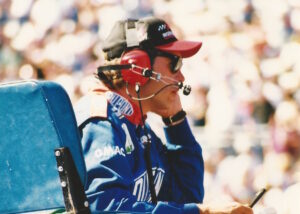
“I keep a lot of plates spinning,” says Ray Evernham, the three-time NASCAR championship-winning crew chief during his days working with Jeff Gordon and the Hendrick Motorsports team. “Every day I wake up and appreciate my life. Some days I think I just don’t deserve all the cool stuff that I get to do.”

In his roughly 50 years of participating in all forms of motorsport, Evernham has indeed done some very “cool” things on both sides of the pitlane. From racing on short track ovals with dreams of winning the Indy 500, to his work in both the IROC racing series and NASCAR — not to mention founding charities and amassing an incredible collection of classic cars — he’s enjoyed an incredibly successful career. But Evernham will be the first to admit it wasn’t always easy going.
He recently sat down with Linkage to discuss the many ups, and few downs, he’s experienced over the years. When asked what first drew him into cars and racing, Evernham admits he’s not really sure how it happened.

“I get asked that a lot and I think a lot of people are waiting for this super great and interesting answer. The truth is, I really don’t know, because I’ve never not wanted to. I never remember not being crazy about cars.”
Born in Hazlet, New Jersey, in August 1957, Evernham says one of his first memories is of being 3-4 years old and “driving the wheels off” his pedal car. It wouldn’t take long for him to start piloting far more powerful machinery around racetracks and into a victory circle. At 15 years old, Evernham got a job at a local gas station that allowed him to save enough money to buy his first racecar. The owner was a racing fan and helped inspire dreams of glory by handing over a variety of racing-related papers. With a budget of $450 dollars, Evernham made his race debut at Wall Stadium, a one-third mile track in Belmar, N.J., driving what was then called a modern stock racecar.
“I always tell people I’m the type of person that when you go, you gotta go. Sometimes you jump out of the airplane and build the parachute on the way down,” he says.
In this instance, Evernham’s parachute was being quick behind the wheel. The following year he was named Rookie of the Year. The next year, he was champion of the class. Yet, a series of serious accidents would eventually steer Evernham in a new direction.

A new challenge
In 1983, after a brief stint selling cars at a Lincoln Mercury dealership, he had the opportunity to work for Roger Penske and the International Race of Champions (IROC) organization which had recently moved its headquarters to Tinton Falls, N.J. Under the tutelage of Jay Signore, who served as the President of IROC from 1974 to 2007, Evernham learned valuable lessons that would carry him to a NASCAR Hall of Fame career. This included organization, attention to detail, and team building. After seven years with IROC, however, Evernham sought out a new challenge.

“I moved to North Carolina to work for Alan Kulwicki. It was tough because I had to give up on my dream of being a racecar driver. I had my wife, a new baby, we were broke,” he says.
While the working relationship with Kulwicki proved rocky and short lived, Evernham found himself teamed with a gifted driver who’d caught his attention a couple years previously. That driver was Jeff Gordon. The two had briefly worked together and gotten along well. Equally important was the fact that Ford Motorsport also took note of this strong working relationship on the cusp of Gordon making his entry into NASCAR.
“Jeff went to Rick Hendrick and he said, hey, I need this guy Ray to come along with me. I had no intention, never in the story of Ray Evernham did I think of becoming a Winston Cup crew chief. Rick saw much more in me than I saw in myself,” he shares.
Gordon and Evernham began what would become one of the most successful driver/crew chief pairings in history beginning with the 1993 NASCAR Winston Cup season. At season’s end, Gordon was 14th overall in the standings and named Rookie of the Year. Evernham credits a strong bond between the two as being vital to soon-to-be even higher achievements.
“Jeff and I are kind of like brothers. Jeff’s pure and honest and smart. The way we communicated with one another, it was almost immediately a sense of trust. When you get the opportunity to work with someone special, you know it,” he says.

This sense of trust and determination would lead to NASCAR championships in 1995, 1997, and 1998. Evernham credits the entire team which, thanks to its colorful Dupont-sponsored livery came to be known as “The Rainbow Warriors,” as being the reason for such a storied run. This includes times where, Evernham admits, the team outperformed the car itself.
“We won a million bucks at Darlington one time. We should have run about fifth. The driver stepped up, the pit crew stepped up, I made some good calls. That was that whole ‘refuse to lose’ mantra that the team had. They just wouldn’t give up,” he says. “It’s rare to be a part of something like that. Rick Hendrick was the perfect car owner for us because he had the resources and the vision to let us try something different.”
The art of the pit stop
One of the things Evernham is best known for is elevating the art of the pit stop. However, he’s quick to credit legendary teams, such as the legendary Wood Brothers Racing, as proving the importance of getting in and out of pit lane as quickly and efficiently as possible. That being said, there were times when he saw a more nonchalant attitude.

“I remember going to watch a pit practice, and the front tire changer is going over the wall in cowboy boots, smoking a cigarette,” Evernham says with a chuckle. He singles out a track like Daytona Speedway as being a perfect example of leapfrogging the competition via hard work on pit road. At speeds up to 200 miles per hour, a car is traveling about 300 feet per second. Saving two or three seconds in pit lane makes an enormous difference in terms of track position.
With mechanics and engineers working up to 16 hours a day during a race weekend, Evernham devised a new approach.
“I had an idea of using athletes to come in and pit. People told me that won’t work, they don’t know how to work on cars. And I’d tell them, they don’t have to work on the car. All they have to do is put tires on it and put gas in it. For four or five years in a row we owned pit road. The Rainbow Warriors were unstoppable on pit road,” he says.

After many victories and championships with Hendrick Motorsports, Evernham would go on to lead his own Dodge- branded NASCAR team from 2001 to 2007. Success continued with 23 pole positions and 13 race wins. This was followed by years spent in the commentary booth, not to mention as producer and host of the television series AmeriCarna.
Life lately
These days Evernham occupies himself with a wide range of tasks. This includes the Evernham Family Racing for a Reason foundation that supports community centers for young adults with high-functioning Autism and Asperger’s syndrome. It also includes the rejuvenation of the IROC racing series featuring a who’s-who of former NASCAR greats, including Jeff Gordon. Over the years he’s also amassed what he freely admits is a very unique collection of street and racing cars.
“When people come in here, they’re like, your collection is very eclectic. And I’m like yeah, like me. My mind is all over the place,” he shares.
Of all his cars, his favorite is the original 1958 Chevrolet from the 1973’s car-centric movie, American Graffiti. After years of unsuccessfully trying to buy the Impala from the owner who acquired it from the studio, he found it up for auction and finally acquired his dream machine.

“We did the most meticulous restoration on that car. We worked so hard to make that car perfectly imperfect,” he says.
This meant keeping a dent in the rear bumper created in a scene where a street race doesn’t quite go according to plan. The only change made was under the hood. The movie car had a fairly pedestrian V8 engine, whereas in the movie the character “Toad” proudly declares it has a 327 with six Stromberg carburetors.
“Do you know how hard it is to find a 1962 327 with six Strombergs,” Evernham says with a laugh.
Needless to say, he and his trusty crew sourced one and made the car true to its silver-screen promise.
About The Author

More Stories
Car culture, not just preservation, is the future
The Bentley 8 Litre
Sporting Excellence with Understated Elegance